


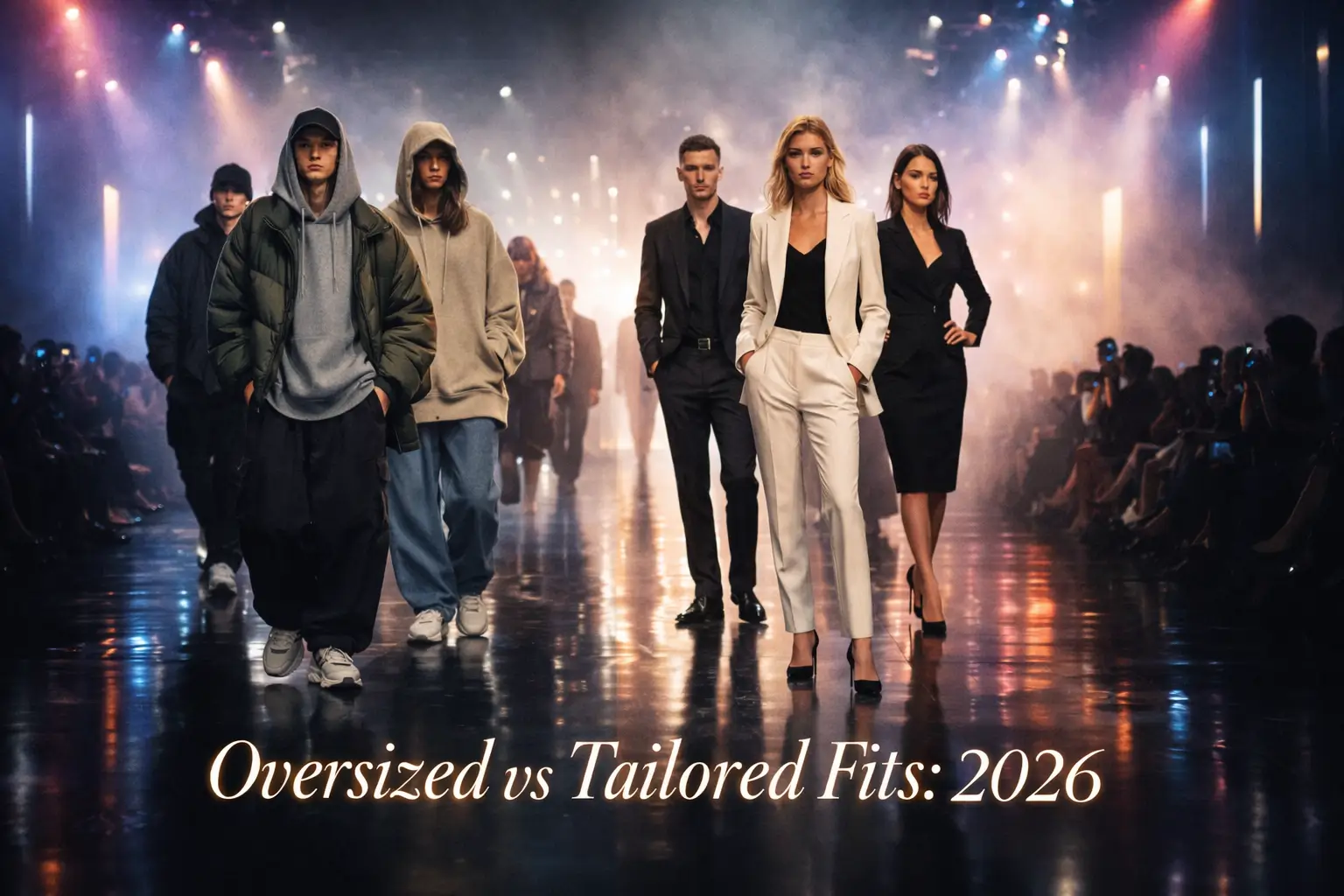
Oversized vs Tailored Fits: The 2026 Style Battle Nobody Saw Coming
Oversized vs Tailored Fits — yeah, we’re going there. Because honestly? I’ve been having this argument with my friend Zara (not the brand, an actual human named Zara) for the better part of three years now. She’s a tailored-fit person through and through. Blazers cinched just right, trousers that actually hit the ankle. Me? I showed up to her birthday dinner in a shirt so big it could’ve housed a small family. She gave me the look. You know the look.
But here’s the thing — both of us were right. And in 2026, that’s more true than ever.
The fashion world right now is basically split down the middle. You’ve got your oversized crowd — draping, layering, intentionally ‘too-big’ everything — and then you’ve got the tailored-fit comeback kids who are saying ‘actually, structure is back, and it never really left.’ So which side wins? Let’s get into it. And I mean really get into it, not some surface-level ‘both are great!’ cop-out.
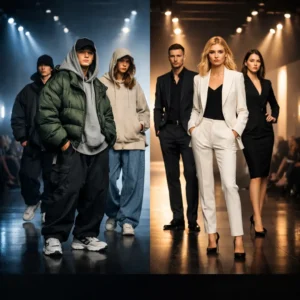
Oversized vs Tailored Fits: A Brief, Weird History
Oversized vs Tailored Fits isn’t a new argument — it’s basically fashion’s version of the chicken and the egg. But the 2026 version has a twist.
Oversized silhouettes weren’t invented by streetwear kids in the 2010s. If you go back to the 80s — and I mean really go back — you’ll find massive shoulder pads, boxy blazers, and power suits that could swallow a person whole. That was tailored AND oversized at the same time. Wild, right? Then came the 90s slim era, then the Y2K low-rise nightmare (we don’t talk about that), then the 2010s normcore wave, and here we are.
What’s different in 2026 is that both aesthetics have genuinely matured. Oversized isn’t just ‘I grabbed my dad’s hoodie anymore.’ There’s actual intention behind it — dropped shoulders engineered with precision, wide-leg trousers that flow, not flop. And tailored fits have loosened up. Seriously. The rigid, suffocating slim suits of the early 2010s? Gone. The new tailored look breathes. It moves. It’s not trying to look like a magazine ad from 2009.
Oversized vs Tailored Fits: The Cultural Moment We’re In
Oversized vs Tailored Fits in 2026 is really a conversation about identity. What do you want your clothes to say about you?
Here’s something that doesn’t get talked about enough: the pandemic (yes, we’re still feeling its ripples) fundamentally changed how people relate to their bodies and their clothes. When you spend two years in sweatpants, you start asking questions. Why was I wearing things that were uncomfortable? Why did ‘professional’ have to mean ‘restrictive’? Oversized fashion — with its comfort, its ease, its ‘I refuse to be squeezed into a shape for you’ energy — answered those questions loudly.
But then, as the world opened back up and people wanted to feel intentional again, tailored fits came roaring back. Getting dressed with purpose. Choosing structure. Saying ‘I showed up, and I showed up sharp.’ Both of these impulses make total sense. Because they’re not really about fabric — they’re about psychology.
Oversized vs Tailored Fits: The Street Says Both
Oversized vs Tailored Fits on the street in 2026 looks like a beautiful, chaotic mix. Walk through any major city right now — Tokyo, Lagos, Milan, Seoul, New York — and you’ll see people playing with both simultaneously.
I was at a market in Karachi last month (shoutout to Zainab Market, genuinely one of the best places in the world for fabric shopping) and the range was staggering. One person had an oversized linen shirt tucked into perfectly tailored wide-leg trousers. Another had a cropped blazer — structured, sharp — worn over a massive, billowing graphic tee. These people weren’t following trends from a magazine. They were just dressing, and it looked incredible.
That’s the real fashion story of 2026: the binary is dead. But that doesn’t mean there’s nothing to talk about. Choosing deliberately between the two — or mixing them — requires an understanding of what each actually brings.
Oversized vs Tailored Fits: What Oversized Actually Does for You
Oversized vs Tailored Fits — when you break it down, oversized does a few things that tailored simply cannot.
First, it’s democratic. Oversized clothing largely sidesteps body-size pressures in a way tailored clothes inherently cannot. You’re not trying to ‘flatter’ in the traditional, frustrating sense. You’re existing. Comfortably. That’s not a small thing.
Second, oversized creates visual interest through proportion play. A huge coat over slim trousers? That contrast is doing real aesthetic work. It’s not accidental. The best oversized dressers are actually incredibly calculated — they just make it look effortless.
Third — and this is the niche insight fashion people don’t always admit — oversized clothes age better in terms of style. A perfectly cut slim suit from 2012 now looks like a costume. An oversized trench from the same era? Still works. Something about volume has a way of transcending ‘of its moment.’
The downside, though? If you don’t know what you’re doing, oversized becomes shapeless. And shapeless isn’t a vibe — it’s just… lost. There’s a massive difference between intentional volume and ‘I couldn’t find a mirror this morning.’
Oversized vs Tailored Fits: What Tailored Brings to the Table
Oversized vs Tailored Fits gets interesting when you really look at what good tailoring does — because it’s not what most people think.
Tailored doesn’t mean tight. That’s the misconception that ruined an entire decade of men’s fashion. Real tailoring — proper, thoughtful tailoring — is about aligning the garment with the body’s natural lines. Room to move. Fabric that falls correctly. Not ‘painted-on.’ The Italian term is ‘sartoria,’ and there’s a reason it sounds like an art form. Because it is.
What tailored fits give you that oversized doesn’t: sharpness of intention. When you walk into a room in a well-tailored suit or even a simple fitted trouser and structured blouse, there is a clarity to you. People know you came with a plan. It signals investment — not just monetary, but personal.
There’s also something genuinely underrated about how tailored clothing makes you feel. I borrowed a bespoke jacket from my uncle once (he’s very fancy, I am not) and wore it to a work presentation. Something clicked. I stood differently. Spoke differently. Placebo? Maybe. But the placebo was real.
The risk with tailored fits in 2026? Being stuffy. There’s an incredibly fine line between ‘polished’ and ‘stiff.’ The people who pull off tailored best these days are the ones who throw something unexpected into the mix — a graphic tee under the blazer, white sneakers with the suit trousers, a beanie with the sharp overcoat. Rule-breaking within structure.
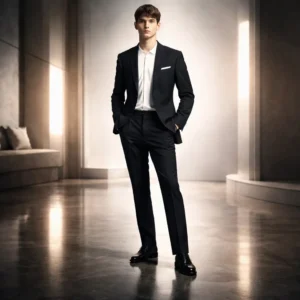
Oversized vs Tailored Fits: What’s Actually Trending in 2026
Oversized vs Tailored Fits — so where is the actual trend needle pointing right now?
Honestly? ‘Relaxed tailoring’ is eating everybody’s lunch. It’s the middle-ground answer that somehow satisfies both camps. Think structured shoulders but a looser body. Trousers with a proper crease but a wide leg. Blazers that button properly but with enough room to layer a thick knit underneath. It’s tailoring with an exhale.
On the other side, ‘intentional oversized’ is getting more refined. The oversized pieces trending in 2026 are often technically impeccable — complicated construction hidden under an apparently simple silhouette. There’s a lot of Scandinavian design influence here. Cos, Arket, some of the more thoughtful South Korean brands doing things with volume that feel genuinely architectural.
What’s dying? The sloppy-oversized aesthetic — where it just looks like you grabbed something too big because it was there. And equally dying is the aggressively slim tailored look — anything that cuts off circulation is officially out.
A niche detail worth knowing: in menswear specifically, the ‘pleated trouser revival’ is one of the quietest but most significant things happening right now. Pleats were considered dad-fashion for years. Now they’re a mark of someone who genuinely knows what they’re doing. They allow volume through the hip and thigh, then taper cleanly. It’s clever engineering, and it bridges the oversized-tailored divide in a single garment.
Oversized vs Tailored Fits: Building an Actual Wardrobe in 2026
Oversized vs Tailored Fits as a wardrobe strategy — let’s get practical for a second.
The smartest approach in 2026 isn’t picking a side. It’s building a wardrobe with intentional anchors from both camps. Here’s how I’d actually think about it:
Start with tailored foundations. A well-fitted blazer (not slim-cut — fitted, there’s a difference). Trousers with a proper break. One or two structured pieces that form the backbone of the wardrobe. These are your ‘I need to look like I have my life together’ pieces, and they pay dividends.
Then build your oversized layer. An oversized coat is the single most useful garment you can own — it goes over everything, it works in most climates, it makes even a mediocre outfit look considered. An oversized knit or two. A boxy tee. These are your comfort pieces, and in 2026, comfort is still very much a priority.
The magic is in the combination. Tailored trousers plus oversized coat. Oversized shirt tucked into tailored skirt. Fitted turtleneck under a massive blazer. You’re not being indecisive — you’re being sophisticated.
Oversized vs Tailored Fits: The Gender Dimension
Oversized vs Tailored Fits hits very differently depending on how you think about gender in fashion — and in 2026, this is honestly one of the more interesting parts of the conversation.
Tailored clothing has historically been gendered in its very construction. Men’s suits and women’s suits are cut differently, for different bodies, with different assumptions baked in. Oversized fashion, weirdly, is more democratizing — an oversized piece works across bodies and doesn’t make the same assumptions.
What’s happening now is fascinating: tailoring is getting genuinely less gendered. Brands are increasingly making tailored pieces designed for everyone — not just ‘women’s blazers’ cut to a specific assumed shape, but structured pieces with adjustability built in. And oversized menswear is expanding to embrace what was traditionally considered ‘feminine’ volume — flowing fabric, draping, layering.
This isn’t a trend, it’s a structural shift. And it means the Oversized vs Tailored Fits conversation in 2026 is also quietly a conversation about who fashion is actually for. Answer, finally: everyone.
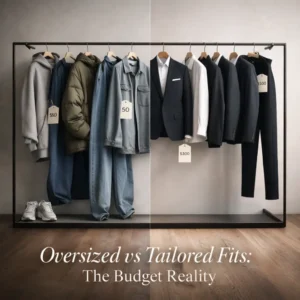
Oversized vs Tailored Fits: The Budget Reality
Oversized vs Tailored Fits — okay, let’s talk money. Because fashion theory is great, but wallets are real.
Good tailoring costs money. That’s just the truth. Custom or even made-to-measure tailoring is an investment, full stop. But — and this is where it gets interesting — a single well-made tailored piece can outlast five poorly made ‘trendy’ items. The cost-per-wear calculation actually favors quality tailoring over time. It’s a delayed gratification game.
Oversized is slightly more forgiving on budget. Because fit is less precise, thrift stores and vintage shops are incredible sources for oversized pieces. That massive wool coat from the 90s? Still works. The boxy blazer from your uncle’s wardrobe from 1987? Genuinely chic right now. The oversized movement has made vintage shopping not just economical but aesthetically on-point.
The strategy then: invest in your tailored anchors (blazer, trousers, one good coat). Hunt vintage and thrift for your oversized layers. You end up with a wardrobe that’s both well-made and interesting without spending like you’re on a TV show.
Oversized vs Tailored Fits: The Verdict (Sort Of)
Oversized vs Tailored Fits — okay, I promised not to give you a ‘both are great!’ cop-out, and I’m gonna try to honor that.
Here’s my actual take: tailored fits win on permanence. A well-tailored piece is harder to get right, more technically impressive, and ages better in terms of quality. When you nail tailored dressing, you have genuinely cracked something.
But oversized wins on freedom. And in a world that has spent a long time telling people how to look and what to wear and what shape to be, freedom in fashion is not a small thing. It’s meaningful. It’s the reason oversized has endured beyond trend cycles.
The 2026 move — and this is genuinely what the most interesting dressers are doing — is to understand both languages fluently. Know why tailoring works. Know why volume works. Then mix them on your own terms. That’s not indecision. That’s sophistication.
My friend Zara and I finally came to an agreement: she lent me her tailored blazer for an event, and I insisted she wear my giant linen shirt over the top of it. She looked phenomenal. I looked like a fashion editor’s mood board. We both won.
So. Oversized vs Tailored Fits in 2026? The answer is yes. Both. Always both. But make it intentional. Make it yours. And please — no slim-cut 2012 suits. That battle, at least, is finally over.
