Luxury Jewelry Trends 2026: What’s Actually Worth Your Money This Year
Okay, real talk. I’ve been obsessed with jewelry since I was maybe nine years old, sneaking into my grandmother’s old wooden jewelry box — the one that smelled like rose water and cedar — and trying on her chunky gold bangles that were way too big for my tiny wrists. Back then, jewelry felt like magic. Like wearing a little piece of someone’s story.
Fast forward to 2026, and honestly? That feeling hasn’t changed. But the trends — oh, they’ve changed. Dramatically. And if you’re someone who actually cares about what you’re putting on your body (and what you’re spending your hard-earned money on), then buckle up. Because Luxury Jewelry Trends 2026 are unlike anything we’ve seen in the last decade.
So, let me break it down. No fluff, no generic “here are five trends” nonsense. Just real insights, some personal opinions, and maybe a little bit of drama. Because jewelry deserves drama.
Luxury Jewelry Trends 2026 Are Being Led by Conscious Consumers
Let’s start here, because this is honestly the biggest shift.
Luxury Jewelry Trends 2026 are being completely reshaped by buyers who actually give a damn about where their stones come from. And I don’t mean that in a preachy way — I mean it in a practical way. Lab-grown diamonds have gone from being the “budget alternative” to being the preferred choice among younger luxury buyers. Wild, right?
Here’s a niche fact most people don’t know: lab-grown diamonds are chemically, physically, and optically identical to mined diamonds. Not similar. Identical. A gemologist literally needs special equipment to tell the difference. And yet, for years, the industry gaslit consumers into thinking they were somehow lesser. That narrative is crumbling in 2026, and good riddance.
Brands like Vrai, Brilliant Earth, and even legacy houses are quietly expanding their lab-grown lines. The margins are better, the ethics are cleaner, and — here’s the part that gets me — the designs are actually bolder because the cost savings allow for more creative risk-taking.
So if you’ve been on the fence about lab-grown stones, consider this your sign. The stigma is gone. The trend is here. And frankly, the earth thanks you.

Luxury Jewelry Trends 2026: Maximalism Is Back (And It Never Really Left)
Remember when “quiet luxury” was the whole thing? Subtle gold chains, barely-there rings, that whole “I’m rich but I want you to have to guess it” vibe? Yeah. That’s still around. But it’s got serious competition now.
Luxury Jewelry Trends 2026 are bringing back maximalism with a vengeance. We’re talking stacked rings on every finger. We’re talking statement necklaces that take up the entire collarbone. We’re talking mismatched earrings that somehow look intentional and brilliant.
I personally love this shift. There’s something so liberating about wearing a big, bold piece of jewelry and not caring if it’s “too much.” Too much for who, exactly?
The maximalist trend in 2026 is specifically leaning into:
- Architectural jewelry — pieces that look like miniature sculptures. Think angular gold cuffs, geometric earrings with unusual negative space, rings that look like they belong in a modern art museum.
- Mixed metals — gone are the days of “you can only wear gold OR silver.” Now? Mix it all. Yellow gold, rose gold, white gold, oxidized silver — layer them, stack them, wear them all at once.
- Oversized pendants — we’re talking pieces that are almost aggressively large. But in the best way possible.
Transition-wise, this shift from minimalism to maximalism didn’t happen overnight. It’s been building since late 2024, and by 2026 it’s fully cemented. Consequently, if your jewelry box is full of dainty pieces, don’t panic — they’re not going anywhere. However, you might want to add a few bold pieces to balance things out.
Luxury Jewelry Trends 2026 Include the Return of Colored Gemstones
Diamonds are forever, sure. But emeralds? Sapphires? Tourmalines? They’re having a moment.
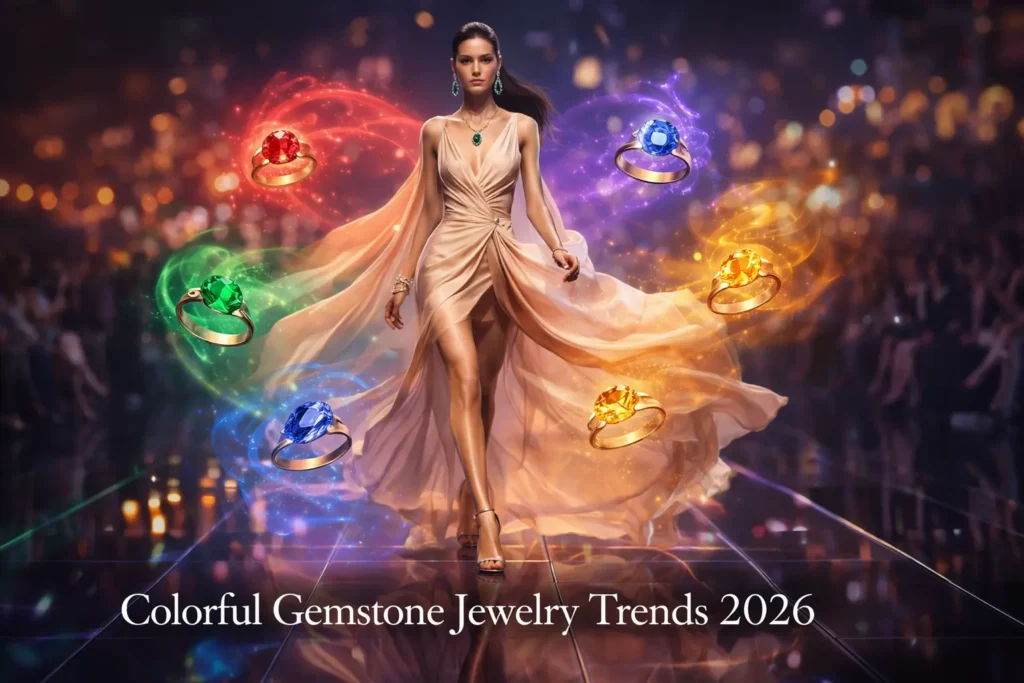
Luxury Jewelry Trends 2026 are deeply colored. Vivid, saturated, unapologetic color is everywhere in fine jewelry right now. And not just the classic rubies and sapphires (though those are absolutely having a renaissance) — we’re also seeing a surge in:
- Paraíba tourmalines (those electric blue-green ones that look like they’re literally glowing from inside)
- Padparadscha sapphires — this pinkish-orange stone from Sri Lanka that I personally think is the most underrated gem in existence
- Alexandrite — the stone that changes color depending on the light. I once saw a piece with alexandrite at a jewelry show in Dubai, and I genuinely could not stop staring at it
Here’s my hot take: colored gemstones are more personal than diamonds. A diamond tells people you spent money. A Paraíba tourmaline tells people you know things. Big difference.
From a trend perspective, this is also connected to the rise of astrological and birthstone jewelry — which, whether you believe in astrology or not, is clearly resonating with consumers. People want jewelry that means something specific to them. Colored stones deliver that in a way that a white diamond often doesn’t.
Luxury Jewelry Trends 2026: Vintage Revival Is Gaining Serious Momentum
Okay so this is the part where I get a little nerdy.
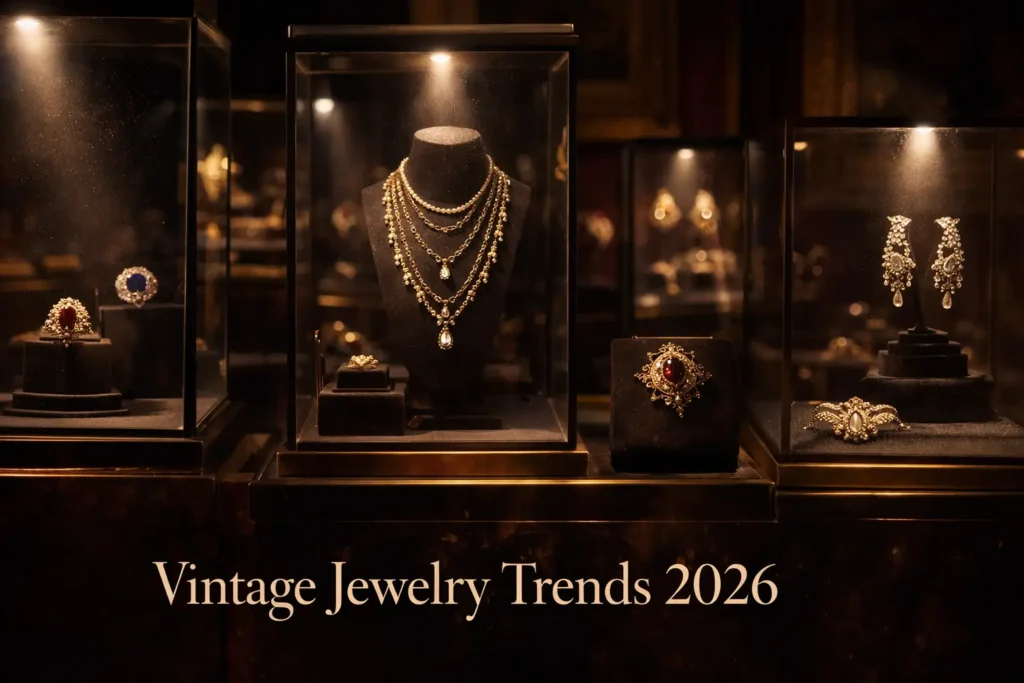
The vintage jewelry revival in Luxury Jewelry Trends 2026 isn’t just aesthetic nostalgia. It’s also smart investing. Pieces from the Art Deco era (1920s-1930s), mid-century modernism (1950s-1960s), and even 1970s boldness are being sought out aggressively by collectors and fashion-forward buyers alike.
And here’s the thing — vintage jewelry has a craftsmanship quality that’s genuinely hard to replicate today. Old European cut diamonds (rounder and chunkier than modern brilliant cuts) have this warmth and glow that modern cuts don’t quite capture. Milgrain detailing, filigree work, hand-engraved settings — these techniques existed before mass production made everything look the same.
I bought a vintage Art Deco ring a couple years ago from an estate sale in Lahore. Paid what felt like a lot at the time. That ring has since tripled in value. Just saying.
Consequently, the smart money in 2026 is on vintage and estate pieces. Moreover, buying vintage is also — wait for it — more sustainable than buying new. So you’re getting history, craftsmanship, investment value, and ethical credentials all in one piece. What’s not to love?
Luxury Jewelry Trends 2026 Are Going Heavy on Personalization
This one isn’t exactly new, but it’s reaching new heights.
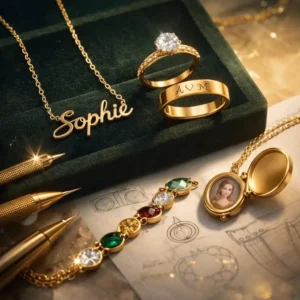
Luxury Jewelry Trends 2026 are obsessed with personalization. Not just initials and birthstones (though those are still going strong), but deeply customized, one-of-a-kind pieces that tell a specific story.
We’re talking:
- Custom engravings with dates, coordinates, song lyrics, or inside jokes
- Signet rings with family crests or custom designs (these have completely exploded in popularity)
- Charm bracelets curated over time — adding a new charm for each milestone, each trip, each chapter of life
- Bespoke commissions — working directly with a jeweler to create something that exists nowhere else in the world
The personalization trend is also intersecting with technology in fascinating ways. Some jewelers are now using 3D printing for prototyping custom pieces, which means the turnaround time on bespoke work has dropped significantly. Additionally, AI-assisted design tools (ironic, given this article) allow customers to visualize their custom piece before a single gram of metal is melted.
There’s something deeply satisfying about wearing a piece that was made specifically for you. That nobody else has. That piece of jewelry my grandmother gave me — the one I mentioned at the start — that’s irreplaceable not because of its monetary value but because of its specificity. That’s what personalization captures. And in 2026, the luxury market is leaning into that hard.
Luxury Jewelry Trends 2026: The Rise of Sustainable and Ethical Fine Jewelry
We touched on lab-grown diamonds, but the sustainability conversation in Luxury Jewelry Trends 2026 goes much deeper.
Fairmined gold — sourced from certified small-scale mines with strict environmental and social standards — is becoming a genuine differentiator for luxury brands. It costs more. It’s worth it. Consumers are increasingly willing to pay the premium, and brands know it.
Beyond gold and diamonds, there’s growing interest in:
- Recycled precious metals — melting down old jewelry and repurposing the metal into new pieces
- Conflict-free sourcing certifications that go beyond the Kimberley Process (which, let’s be honest, has significant loopholes)
- Brands with transparent supply chains — companies that can literally show you the mine, the cutter, the polisher, and the setting artisan behind your piece
Here’s something most jewelry buyers don’t know: the luxury jewelry industry has one of the most opaque supply chains of any consumer goods category. A diamond can change hands 10+ times between mine and retail counter, and tracking it is genuinely difficult. Therefore, brands that are doing the work to create transparency deserve recognition — and your money.
Furthermore, the younger luxury consumer (millennials, Gen Z with disposable income) actively researches a brand’s ethics before purchasing. This is consequently pushing even legacy houses to clean up their act. Cartier, Tiffany, and others are investing heavily in traceability programs. Because if they don’t, they’ll lose the next generation of buyers entirely.
Luxury Jewelry Trends 2026: Wearable Art and Designer Collaborations
Here’s where things get really exciting.
Luxury Jewelry Trends 2026 are seeing a surge in collaborations between fine jewelry brands and contemporary artists, architects, and even fashion designers. The result is jewelry that functions less as accessory and more as wearable sculpture.
Think about it — when a well-known sculptor collaborates with a jewelry house, you get pieces that exist at the intersection of fine art and personal adornment. These are pieces you wear, but also pieces you could hang on a wall and nobody would question it.
Some notable directions this is taking:
- Biomorphic forms — organic, flowing shapes inspired by natural structures (bones, coral, seed pods, flowing water)
- Architectural precision — clean lines, perfect geometry, mathematical beauty
- Narrative pieces — jewelry that tells a story across multiple connected elements (think a necklace where each link represents a different chapter)
The collaboration economy is also producing some genuinely surprising pairings. Streetwear brands and fine jewelry houses. Contemporary painters working in 3D for the first time. Ceramic artists consulting on texture. It’s chaotic in the best possible way.
Luxury Jewelry Trends 2026 Are Redefining Men’s Fine Jewelry
Alright, let’s talk about something that doesn’t get nearly enough attention.
Luxury Jewelry Trends 2026 are seeing a genuine explosion in men’s fine jewelry. Not just watches (which have always been accepted), not just wedding bands — actual jewelry. Chains, rings, bracelets, even earrings.
And the men buying these pieces aren’t doing it quietly or apologetically. They’re doing it boldly, confidently, and with really good taste. Consequently, luxury brands are responding by designing specifically for this market rather than just making “men’s versions” of women’s pieces.
The aesthetic for men’s fine jewelry in 2026 leans toward:
- Heavy chains in yellow gold — substantial, confident, unmistakable
- Signet rings (we mentioned these before, but they’re especially popular among men)
- Single statement earrings — one dramatic drop earring or hoop
- Layered bracelets mixing different materials and textures
Moreover, this isn’t a flash-in-the-pan trend. The cultural shift toward gender-fluid fashion has been building for years, and jewelry is a natural extension of it. Furthermore, historically, men’s jewelry wasn’t unusual at all — it’s really the last 150 years of Western fashion that made jewelry “feminine.” We’re just course-correcting.
Luxury Jewelry Trends 2026: Investment Pieces Worth Considering
Since we’re already here, let me give you my actual opinion on what’s worth buying as an investment in 2026.
Luxury Jewelry Trends 2026 from an investment perspective point toward:
- Vintage signed pieces — jewelry from known houses (Cartier, Van Cleef, Bulgari) from the 1960s-1980s. Prices have been appreciating consistently and show no signs of slowing down.
- Colored gemstones in certified quality — specifically Paraíba tourmalines, Kashmir sapphires, and Burmese rubies with GRS or GIA certificates. These stones are finite, beautiful, and increasingly rare.
- Handcrafted artisan pieces from recognized contemporary jewelers — the secondary market for respected independent jewelers has grown significantly. Think of it like buying from an emerging artist before they blow up.
- High-karat gold pieces — with gold prices where they are in 2026, pieces in 22k or 24k are essentially gold investments you can wear. Practically speaking, they’re not just beautiful — they’re tangible assets.
What I’d avoid? Mass-market “luxury” pieces from brands that outsource all their production and slap a logo on generic settings. You know the ones. They look fine but they hold no value and they’re basically just paying for a name.
Luxury Jewelry Trends 2026: A Few Things That Are Quietly Fading
Okay, in the spirit of balance, let me tell you what I think is on its way out.
Luxury Jewelry Trends 2026 are clearly moving away from:
- Extremely delicate “barely there” jewelry — this had a great run but it’s feeling dated in the maximalist wave
- Rose gold everything — rose gold peaked around 2018-2019 and it’s been slowly fading since. It’s not gone, but it’s definitely no longer the trendy choice
- Tennis bracelets as the default “safe” gift — these are classic, sure, but they’ve lost their distinctiveness from overexposure
Additionally, the era of buying jewelry purely for a logo is waning. People want the quality, not just the name. Brands that rely entirely on logo recognition without delivering genuine craftsmanship are going to struggle with the next generation of luxury buyers.
Luxury Jewelry Trends 2026 and What They Mean for You
So here’s where I land after all of this.
Luxury Jewelry Trends 2026 are, at their core, about meaning. About buying things that matter, that last, that connect to something real. Whether that’s ethical sourcing, personal stories, investment value, artistic vision, or just the pure joy of wearing something beautiful — the best jewelry of 2026 has a reason for existing beyond just filling a display case.
My grandmother’s bangles didn’t follow any trend. They were just… hers. Worn daily for decades until they developed that warm patina that only time creates. And that’s actually the most sophisticated jewelry philosophy there is: buy what you love, buy what lasts, and wear it like you mean it.
The trends will keep shifting. They always do. But the pieces that’ll still be on your wrist or around your neck in 20 years? Those are the ones that meant something the day you put them on.
That’s the real luxury.
Whether you’re shopping for yourself, building a collection, or just here for the jewelry gossip — I hope this gave you something useful. Now go find a piece that makes you feel like a kid sneaking into someone’s jewelry box.