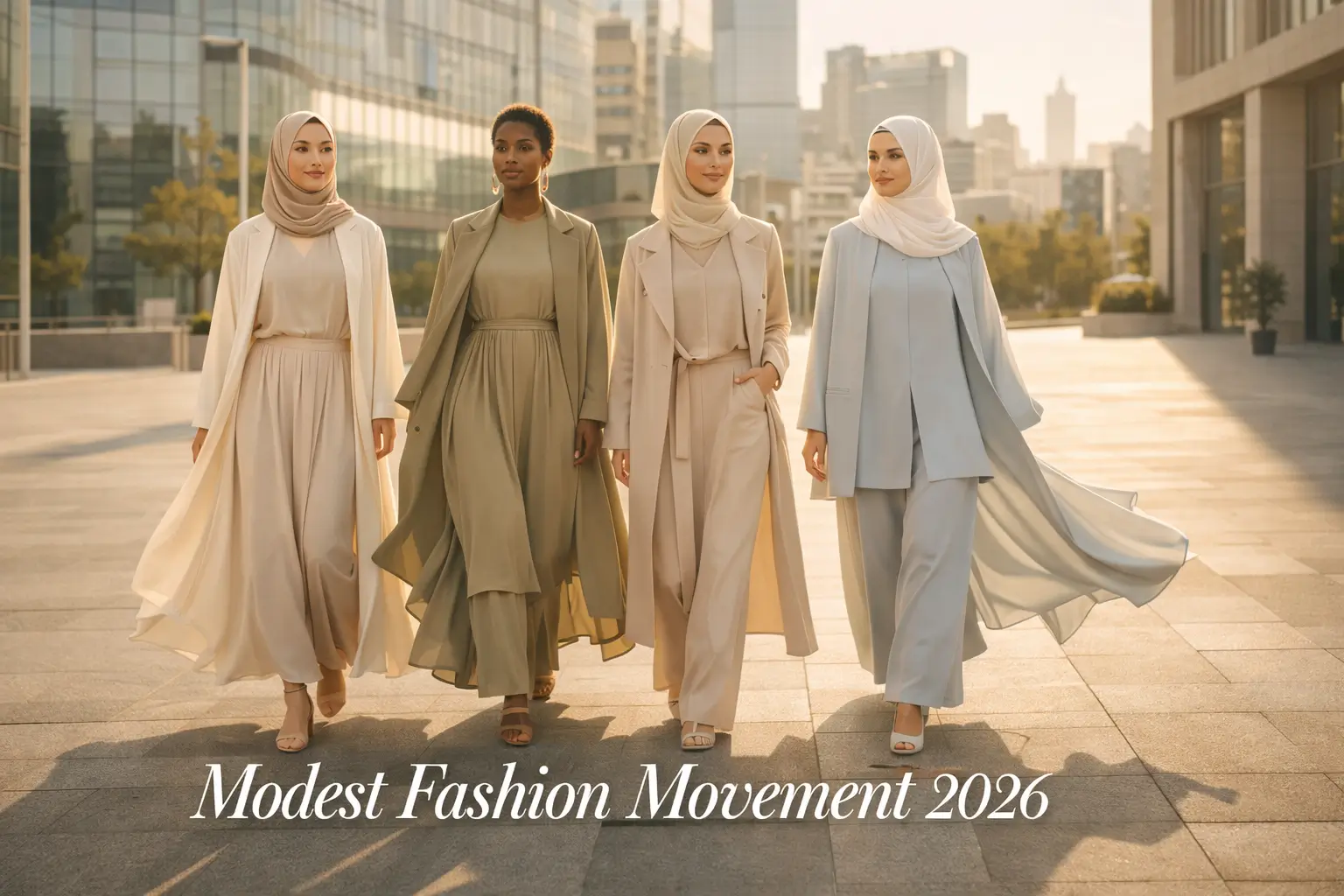
Modest Fashion Movement 2026: How the World Finally Caught Up
Modest Fashion Movement 2026 didn’t just show up quietly — it kicked the door open. And honestly? I saw this coming years ago when my cousin came back from Kuala Lumpur wearing this incredibly structured abaya layered over wide-leg trousers, and every single person at our family dinner stopped mid-bite to ask where she got it. That was three years back. Now, what she was doing is on the runways of Milan, the streets of Brooklyn, and weirdly enough, the fashion pages of magazines that used to pretend modesty didn’t exist.
So, what actually happened? How did modest dressing go from being a niche, often misunderstood category to a full-blown global movement that’s reshaping entire supply chains, redefining influencer culture, and making fashion editors scramble to update their vocabulary? Let’s get into it — but not in that stuffy, academic way. More like how I’d explain it over a cup of chai.
Modest Fashion Movement 2026: It’s Not What You Think It Is
Modest Fashion Movement 2026 is, first and foremost, a mindset shift. For a long time — and I mean a looong time — modesty in fashion was treated like a compromise. Like you were giving something up. Covering more skin meant you were somehow less fashionable, less relevant, less… seen. Which is, if you actually think about it, a pretty wild assumption.
What 2026 proved — and is still proving as the year rolls forward — is that modesty and style are not opposites. In fact, the most visually stunning looks right now are coming from designers and everyday people who are working with fabric, volume, layering, and proportion in ways that genuinely feel new. It’s architectural. It’s intentional. It’s — dare I say it — more interesting than a lot of the minimalist skin-baring stuff that dominated for the better part of a decade.
And crucially, it’s not coming from one place. This isn’t a single-culture trend that got appropriated and watered down. The Modest Fashion Movement in 2026 has roots in Muslim fashion, Jewish tzniut traditions, East Asian aesthetic sensibilities, African heritage dressing, South Asian bridal and everyday wear, and even the Christian modesty communities in the American Midwest that nobody in high fashion was paying attention to. All of these threads — pun absolutely intended — are woven together into something genuinely global.

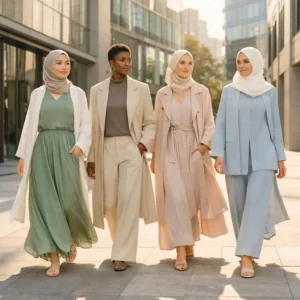
Modest Fashion Movement 2026 Trends Taking Global Runways by Storm
Modest Fashion Movement 2026 trends are honestly some of the most wearable, versatile looks I’ve seen in years. And I’ve been following fashion since I was twelve, dog-earing pages in magazines my mum bought from the corner shop. There’s something different happening right now — it feels less like fashion dictating to people and more like people finally dictating to fashion.
So what are the actual trends? Because yeah, we can talk philosophy all day, but let’s be real — people wanna know what’s in their shopping cart.
Oversized blazers in earthy neutrals are everywhere. Not the boxy, ill-fitting kind from the early 2010s — we’ve graduated from that phase, thankfully — but structured, tailored oversized pieces in camel, warm ivory, deep olive, and rust. Pair them with wide-leg trousers or even a long pleated skirt, and you’ve got an outfit that looks like it walked off a set in Seoul or Istanbul.
Maxi dresses are back, but with an edge. We’re talking silk or satin-look fabrics with interesting necklines — high necks, modest cowls, structured boat necks — in jewel tones that feel rich rather than dowdy. The key difference from five years ago is that these aren’t frumpy. They’re cinched, layered, accessorized thoughtfully. Consequently, they’ve become a genuine uniform for women who need to look polished without compromising their values or their comfort.
Layering is, without question, the skill of the moment. Specifically, the kind of layering that comes from cultures where it’s been practiced for generations. A longline cardigan over a turtleneck over a midi skirt. A lightweight linen duster over a structured jumpsuit. Multiple fabrics, multiple textures, all working together. Furthermore, because brands are finally catching on, coordinated layering sets are showing up at every price point.
Head covering as style — not just as religious obligation — is perhaps the most culturally significant trend of the year. Turbans, structured wraps, artistic hijab styling, and fashionable head scarves among non-Muslim women who’ve simply decided they love the look. This one is nuanced and occasionally controversial. But the conversation it’s sparking is important and overdue.
Modest Fashion Movement 2026: The Designers Leading the Charge
Modest Fashion Movement 2026 has its heroes — and some of them are names you might not have heard yet, which is honestly the exciting part.
Rabia Z, the Dubai-based designer who’s been at this since before modest fashion was a hashtag, is finally getting the global mainstream recognition she deserved a decade ago. Her work blends Gulf aesthetics with international silhouettes in a way that feels simultaneously timeless and very much of this moment. Meanwhile, designers out of Lagos are bringing West African textiles and silhouettes into the modest fashion conversation with an absolute confidence that makes you stand up and pay attention.
Then there’s a whole wave of second-generation immigrant designers — raised between cultures, fluent in more than one visual language — who are arguably doing the most interesting work of all. Their collections don’t feel like they’re making a statement about identity politics. They just feel like deeply personal, deeply beautiful clothes. Additionally, major Western luxury houses are no longer just doing token modest capsule collections — they’re integrating modest sensibilities into their core lines. That’s a telling sign of where the market is heading.
Also worth noting — and I say this as someone who spent years working adjacent to fashion retail — is the rise of modest fashion in the athleisure space. Sports hijabs, full-coverage swimwear, modest activewear in technical fabrics that actually perform. Nike started the conversation years ago, but the field is now crowded with smaller, more specialized brands who are genuinely innovating.
Modest Fashion Movement 2026 and the Social Media Effect
Modest Fashion Movement 2026 would simply not exist at this scale without the internet — and more specifically, without a generation of content creators who built audiences by just being themselves.
Think about it. Five years ago, if you searched modest fashion on any major platform, you’d get a handful of creators, mostly focused on Islamic modest wear, mostly speaking to a specific demographic. Now? The landscape is unrecognizable. There are modest fashion accounts in Korean, in Swahili, in Portuguese. There are creators in São Paulo doing modest Afro-Brazilian style. There are Jewish women in Brooklyn documenting their tzniut-inspired outfits with the same aesthetic precision as any high-fashion editorial. There are Mormon women in Utah who have become genuinely influential in the global fashion conversation.
What happened is simple, even if the execution was anything but: algorithms started rewarding authenticity, and these creators were as authentic as it gets. They weren’t performing modesty for a niche. They were living it, styling it, breathing it — and the rest of the world found it compelling. Subsequently, brands noticed the engagement numbers and started investing, which brought better products, which brought more creators, which brought more mainstream attention. It’s a beautiful feedback loop, and it’s still accelerating.
I’ll be straight with you though — it’s not all sunshine and silk hijabs. There are real conversations happening about co-opting and commercialization. When a fast fashion brand slaps the word ‘modest’ on a collection it designed in forty-eight hours, the communities who built this movement feel it. That tension is real, it’s valid, and frankly it’s a sign that modest fashion has arrived — because industries don’t get co-opted until they matter.
Modest Fashion Movement 2026: A Sustainability Story Nobody’s Telling
Modest Fashion Movement 2026 and sustainable fashion are, perhaps surprisingly, natural partners — and this is the angle I don’t see enough people writing about.
Here’s the thing: modest dressing, by its very nature, favors quality over quantity. When you’re investing in well-constructed, versatile pieces that cover more of the body and work across multiple occasions, you’re inherently moving away from the disposable, wear-once model that has made fast fashion so destructive. A beautifully made abaya or a quality longline coat is a piece you keep, maintain, and wear for years. That’s not just good ethics — it’s good economics.
Moreover, many of the smaller modest fashion brands — particularly the ones that started as community-driven enterprises — have sustainability baked into their DNA. They source locally, produce in small batches, work directly with artisans. Consequently, they’re already operating in the way that the fashion industry as a whole is supposed to be evolving toward.
There’s also something interesting happening with natural fabrics specifically. Linen, organic cotton, hand-woven textiles, deadstock fabrics — these materials are showing up disproportionately in modest fashion collections because they lend themselves to the kind of beautiful, drapey, textured dressing that the aesthetic demands. As a result, there’s an accidental alignment between modest fashion and the slow fashion movement that I think will only deepen over time.
I remember visiting a textile market in Istanbul a few years back — Kapalıçarşı, the Grand Bazaar specifically — and being struck by how the fabrics there, the handwoven silks and block-printed cottons, were essentially the raw material for everything modest fashion is now gravitating toward. These traditions predate fast fashion by centuries. In some ways, the Modest Fashion Movement is fashion coming back to its senses.
Modest Fashion Movement 2026: Global Markets That Are Exploding
Modest Fashion Movement 2026 is not just a cultural phenomenon — it’s a genuinely massive economic opportunity, and certain markets are moving faster than others.
Southeast Asia — and Malaysia specifically — has been a powerhouse in this space for years, and in 2026 it’s functioning as a sort of creative capital for the global movement. Kuala Lumpur’s fashion scene is producing designers, brands, and content creators who are genuinely setting trends rather than following them. When Malaysian brands show internationally, they’re not presenting as niche ethnic wear. They’re presenting as global fashion.
The Gulf states — Saudi Arabia, the UAE, Qatar — have historically been important markets for modest fashion, but what’s shifting in 2026 is that they’re increasingly producing the fashion rather than just consuming it. Saudi designers in particular are having a moment. The cultural changes happening within the Kingdom are complex and ongoing, but one visible outcome has been an explosion of creative expression in fashion.
Turkey has long been a hub for modest fashion manufacturing and design, and Istanbul’s modest fashion week continues to grow in prestige. Additionally, Indonesia — the world’s largest Muslim-majority country — is developing a domestic modest fashion industry that’s increasingly sophisticated and export-oriented.
Meanwhile, in the West, the growth is coming from diaspora communities and, increasingly, from non-religious consumers who’ve simply fallen in love with the aesthetic. In cities like London, Toronto, and Houston — places with large, fashion-forward Muslim communities — modest fashion is mainstream to the point where it barely gets a second glance. Which is, come to think of it, exactly where it should be.
Modest Fashion Movement 2026: What Critics Still Get Wrong
Modest Fashion Movement 2026 still faces criticism — some of it worth engaging with, some of it frankly pretty ignorant. Let me break down both, because I think honesty serves everyone better than cheerleading.
The most persistent critique from progressive quarters is that modest fashion, particularly when religiously motivated, represents a form of patriarchal control over women’s bodies. This is a serious argument that deserves serious engagement. However — and this is the part that often gets glossed over — the vast majority of women participating in the Modest Fashion Movement in 2026 are doing so by choice. They’re not covering because they were told to. They’re covering because it aligns with their values, their identity, and increasingly, their personal aesthetic.
There’s also the critique from within religious communities — particularly conservative ones — that the fashionization of modest dress trivializes its spiritual meaning. I get that. I genuinely do. When your grandmother wore a headscarf as an act of devotion and it’s now being repurposed as a festival accessory by someone who read one article about boho chic, that’s… a lot. The conversation around intention and context matters, and frankly, the modest fashion community is having it more honestly than most.
The less thoughtful critique is basically just discomfort with the visible presence of religious identity in mainstream spaces. That one I have less patience for. The era of fashion being a religiously neutral, Western-default space is over. Moreover, it was never actually neutral — it just defaulted to a specific cultural norm so thoroughly that the norm became invisible. Modest fashion makes that default visible, and that discomfort is actually productive.
Modest Fashion Movement 2026: How to Actually Dress Well in It
Modest Fashion Movement 2026 is, at its core, still just fashion. Which means there are good ways and less good ways to do it, and a pretty solid breakdown of practical tips is genuinely useful.
Start with fit. This sounds obvious but it’s the single most common mistake in modest dressing. The assumption that more coverage means baggier is wrong, and it’s actively working against you. Clothes that are too big don’t look modest — they look unkempt. In contrast, clothes that are properly fitted, just covering more surface area, look intentional and beautiful. Invest in a tailor. Seriously. A forty-dollar alteration can transform a hundred-dollar piece.
Build your wardrobe around a color system. Modest fashion lends itself to tonal dressing — wearing different shades of the same color family — because it creates a visually cohesive look across multiple layered pieces. Additionally, neutrals give you maximum flexibility, but don’t be afraid of color. A monochrome outfit in deep emerald or warm terracotta can be showstopping.
Fabric matters enormously. This is where modest fashion can go wrong quickly. Fabrics that cling, that are see-through, or that don’t drape well will undermine the whole thing. Accordingly, linen, crepe, ponte, structured jersey, and wool blends are your friends. Satin and silk can work beautifully with the right layering. Cheap polyester, however, will read as cheap polyester regardless of how much of it you’re wearing.
Accessories are the secret weapon. Because modest fashion often involves more fabric, the wrong accessories can make an outfit feel overwhelming. Therefore, the aesthetic rewards restraint — one statement piece, clean lines, quality over quantity. A beautifully crafted leather bag, simple gold jewelry, or an interesting belt can elevate the entire look.
Modest Fashion Movement 2026: Where We Go From Here
Modest Fashion Movement 2026 is, in many ways, still at the beginning of its mainstream chapter — even though it feels like it’s everywhere right now. Because here’s the honest truth: global fashion is still catching up to communities that have been doing this beautifully for generations.
The next phase will be about depth rather than breadth. Sure, the trend has spread wide. However, the real work — building genuinely inclusive supply chains, supporting designers from the communities that originated this aesthetic, pushing for representation in fashion media — is ongoing. The hashtag went mainstream. The economics, the representation, the respect — those are still works in progress.
Furthermore, I think we’ll see more interesting intersections. Modest fashion and genderless fashion are already starting to overlap in fascinating ways. Modest streetwear is evolving into its own distinct genre. The modest bridal market — which is, by the way, enormous and almost criminally underserved by mainstream bridal media — is about to have its breakout moment.
And perhaps most excitingly, modest fashion is starting to influence the design language of mainstream fashion in ways that aren’t being labeled as such. When a mainstream designer adds a longer hemline, chooses a higher neckline, or builds a collection around layering — that’s the influence of the modest fashion movement, even if nobody names it that. Therefore, the impact is bigger than the category.
Modest Fashion Movement 2026: The Final Word
Modest Fashion Movement 2026 is the kind of shift that, ten years from now, people will look back on as obvious. Of course it happened. Of course a world that contains over two billion Muslims, plus hundreds of millions of other people with religious, cultural, or personal reasons to dress modestly, eventually produced a fashion movement powerful enough to change the industry. Of course communities that had been styling themselves beautifully for generations eventually got their moment.
But it doesn’t feel inevitable when you’re inside it. It feels like something that was built, piece by piece, outfit by outfit, by women and designers who kept showing up and kept creating even when the mainstream wasn’t watching.
My cousin — the one at the family dinner in the layered abaya — started her own modest fashion label last year. It’s small, it’s beautiful, and it’s doing pretty well. Every time I see her latest collection, I think: this is what it looks like when fashion finally listens. As a result of everything the movement has built, she has a community waiting for her work, platforms to share it on, and a market ready to receive it.
That’s the real story of Modest Fashion Movement 2026. Not the runway shows or the trend reports or the market projections — though those matter too. It’s the individual people, the real designers, the everyday women getting dressed in the morning and choosing to express themselves fully, without apology, in clothes that reflect who they actually are. That’s always been what fashion, at its best, is supposed to be.