


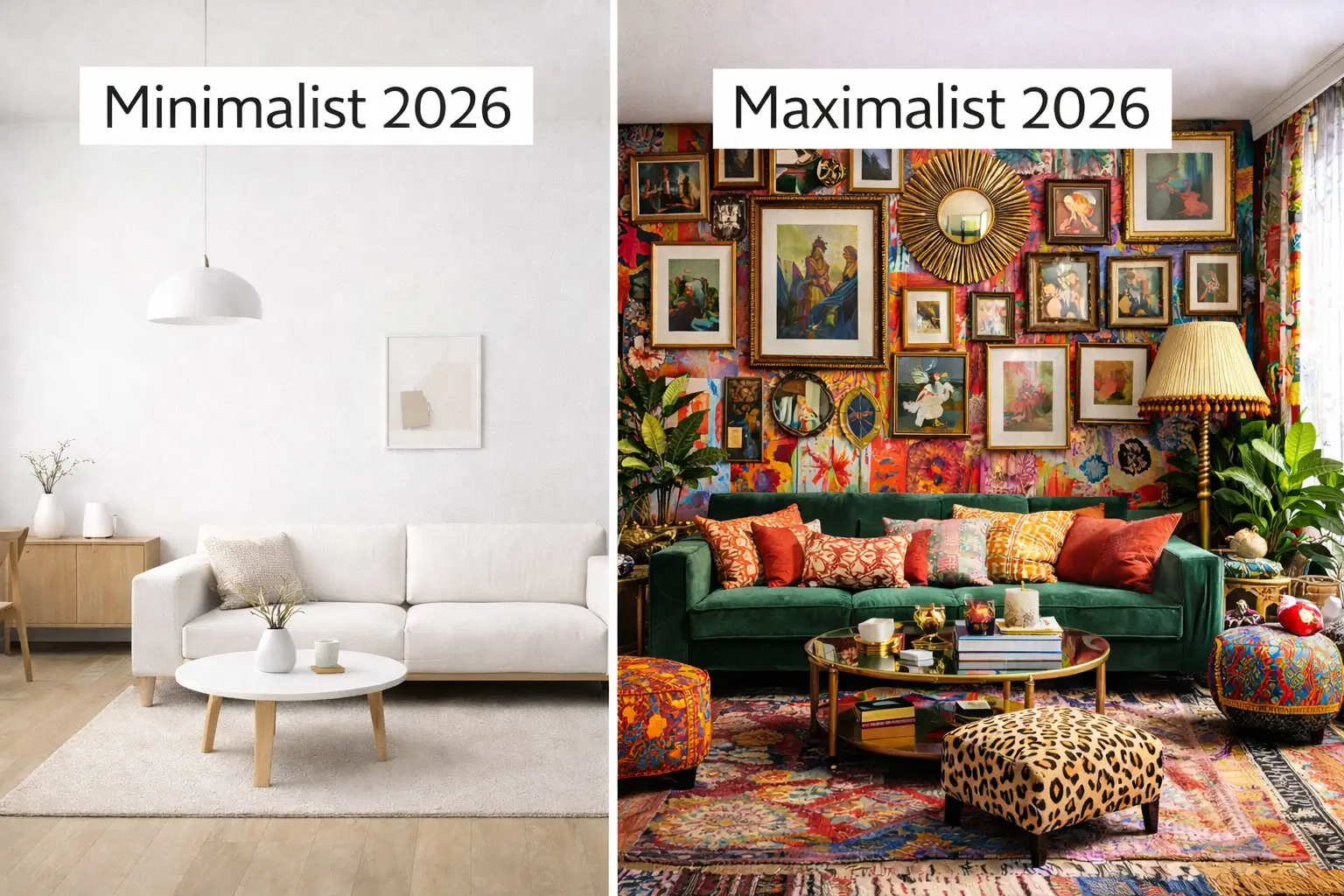
Minimalist vs Maximalist: Which Trend Will Rule 2026?
Minimalist vs maximalist — honestly, I’ve been going back and forth on this debate for years. My living room has seen both phases. There was a period, probably around 2019, where I tossed out almost everything. White walls, one plant, a single throw pillow that cost way too much. I thought I’d found enlightenment. Then, about two years later, I found myself aggressively buying vintage ceramics, layering rugs, and pinning maximalist rooms on Pinterest at midnight. Sound familiar?
The thing is, both aesthetics have genuine, passionate followings. And as we roll into 2026, the design world — along with fashion, lifestyle, and even tech branding — is asking a pretty loaded question: which one wins? Spoiler: it’s not as simple as picking a side. But we’re gonna dig into it anyway, because the conversation is way more interesting than you’d expect.
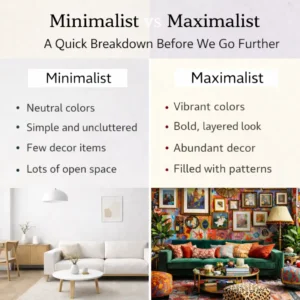
Minimalist vs Maximalist: A Quick Breakdown Before We Go Further
Minimalist vs maximalist isn’t just an interior design conversation anymore — it’s basically a lifestyle philosophy. Minimalism, in its modern form, is rooted in the idea that less is genuinely more. Clean lines, neutral palettes, functional furniture, and absolutely no clutter tolerated. Think Japanese wabi-sabi meets Scandinavian hygge. It’s calm, deliberate, and in theory, deeply intentional.
Maximalism, on the other hand, is the art of saying yes to everything you love and then finding a way to make it all work together. Bold colors, layered textures, gallery walls, pattern mixing, and rooms that look like they belong to someone with a fascinating story and zero chill about editing. It’s expressive, loud, and honestly? It’s making a massive comeback.
Neither approach is wrong. But understanding where each one is heading in 2026 helps you figure out which aesthetic actually suits your life — not just what looks good on someone else’s Instagram.
Minimalist vs Maximalist in Interior Design: What’s Actually Happening in 2026
Minimalist vs maximalist in interior design has been a seesaw for the better part of a decade. But here’s what’s fascinating about 2026 — both aesthetics are evolving, and they’re doing it in ways that make them harder to keep in separate boxes.
Minimalism in 2026 isn’t the cold, clinical version from the early 2010s. Nobody’s living in an all-white apartment with one fork anymore (or if they are, they’re not posting about it). The new minimalism is warmer. Earthy tones — terracotta, warm beige, moss green — are replacing stark whites. Curved furniture is everywhere. Think Boucle sofas that look like they give great hugs, arched doorways, and rounded coffee tables. It’s minimalism that actually wants you to sit down and stay a while.
Maximalism, meanwhile, has gone from ‘more is more’ to something more like ‘more is more, but make it cohesive.’ Designers in 2026 are calling this ‘curated maximalism’ — and it’s as contradictory and brilliant as it sounds. You’re seeing spaces that are absolutely packed with personality but somehow don’t feel chaotic. The secret? Color theory, repeated motifs, and a genuine commitment to the idea that every single thing in the room should mean something to you.
My friend Layla — she’s an interior stylist based in Lahore — told me something that stuck with me. She said her clients used to come in asking for one or the other. Now, almost everyone wants ‘something in between.’ That’s not indecision. That’s the market speaking.
Minimalist vs Maximalist in Fashion: The Runway Has Opinions
Minimalist vs maximalist in fashion is arguably where the debate gets the most heated. Fashion has always been a pendulum, and right now? That pendulum is swinging hard toward maximalism. But let’s not write minimalism’s obituary just yet.
Look at what’s been happening on runways over the past couple of seasons. Brands that built their entire identity on clean, understated luxury — think quiet fashion, stealth wealth dressing — are still doing well. Particularly among a certain demographic that associates restraint with taste. A perfectly cut camel coat, a simple black trouser, quality over quantity. That ethos isn’t dying. It’s just not dominating the conversation the way it was in, say, 2021 or 2022.
Because right now, maximalism is having its moment in fashion in a big, unapologetic way. We’re talking sequins at brunch, clashing prints worn on purpose, jewelry stacked to the point of absurdity, and color combinations that would’ve given fashion editors heart palpitations in 2018. Gen Z, in particular, has fully embraced the idea that getting dressed should be an event. Dopamine dressing — wearing colors and patterns specifically to boost your mood — became a thing during lockdown and never really left.
What’s interesting, though, is that even the maximalist fashion crowd is getting more intentional. It’s not just grabbing everything sparkly and hoping for the best. There’s actual thought going into the chaos, which, when you think about it, is a very minimalist approach applied to a maximalist outcome. Go figure.
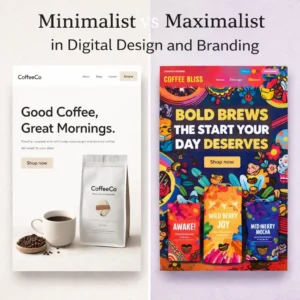
Minimalist vs Maximalist in Digital Design and Branding: The Corporate Angle
Minimalist vs maximalist isn’t just for your home or your wardrobe — it’s a massive conversation in digital design and branding, and the stakes there are genuinely high. Because your brand’s visual identity is basically its first handshake with the world, and getting it wrong is expensive.
For years, the tech industry was obsessed with minimalism. Flat design, sans-serif fonts, lots of white space, and icons that looked like they were designed by someone who’d taken a vow of visual silence. Apple basically set the template, and everyone followed. And honestly? It worked. Clean, fast, intuitive — minimalism in UX design isn’t going anywhere because it serves a real functional purpose.
But in brand identity and marketing? Maximalism is creeping in. Brands trying to stand out in a saturated market — especially consumer brands targeting younger audiences — are leaning into bold colors, retro-inspired typography, layered visuals, and designs that feel almost deliberately overwhelming. Think of the resurgence of Y2K aesthetics in branding, or the way food and lifestyle brands have started using busy, collage-style visuals that feel almost anti-digital. It’s a reaction to everything looking the same. When every tech company has a pale blue logo and a clean sans-serif, the brand that shows up with something chaotic and colorful is actually the one that gets remembered.
Conversely, some maximalist brands are quietly pivoting back toward simplicity as they mature — because there’s a point where visual noise stops being exciting and starts feeling exhausting. The pendulum. Always the pendulum.
Minimalist vs Maximalist: The Psychology Behind Your Aesthetic Preference
Minimalist vs maximalist might feel like a design debate, but it’s also — and I find this genuinely fascinating — a window into how you process the world. There’s actual psychology here.
Research into environmental psychology has consistently shown that cluttered environments can increase cortisol levels. That’s the stress hormone. So the minimalism crowd isn’t wrong when they say a tidy space calms the mind — for many people, it literally does. If you’re someone who feels overwhelmed easily, who needs visual quiet to think clearly, minimalism isn’t just an aesthetic preference. It’s a coping strategy that happens to look really good.
But here’s the thing people don’t talk about enough: for a significant chunk of the population, sparse environments feel cold, isolating, even depressing. Humans are deeply wired to be surrounded by meaningful objects. Our belongings tell our stories. A maximalist space filled with travel souvenirs, family photos, books you’ve actually read, and plants you’ve grown from cuttings — that’s not clutter. That’s identity made physical. And for those people, stripping all of that away in the name of minimalism doesn’t bring peace. It brings a kind of low-grade grief.
Neither reaction is wrong. But understanding which camp you actually fall into — rather than which one looks better in home decor magazines — is, I’d argue, the most important design decision you can make.
Minimalist vs Maximalist: Which Trend Is Gaining More Ground in 2026?
Minimalist vs maximalist in 2026 — okay, let’s actually answer the question. If we’re looking at cultural momentum, social media engagement, and where the creative energy seems to be flowing, maximalism is currently having the louder moment. Particularly in fashion, interior design, and visual branding.
The numbers back this up too. Pinterest’s 2025 trend reports highlighted ‘eclectic maximalism’ as one of the fastest growing search categories. TikTok’s interior design community — which is enormous and genuinely influential — has seen a massive surge in maximalist room tours that rack up millions of views. Meanwhile, the ‘clean aesthetic’ hashtags that dominated around 2020-2022 have lost some of their grip.
But — and this is a big but — minimalism isn’t losing. It’s transforming. The people who are committed to a cleaner, more intentional aesthetic aren’t abandoning it. They’re refining it. Warm minimalism, as it’s being called, is basically minimalism with an emotional intelligence upgrade. It keeps the discipline but adds soul. And that version of minimalism? Still incredibly popular, particularly among the 30-45 demographic who want calm in their homes because their lives are already plenty chaotic.
So the more accurate answer isn’t ‘maximalism wins’ or ‘minimalism wins.’ It’s that we’re heading into an era where the binary is dissolving. The most compelling design choices of 2026 are happening in the space between the two — and honestly, that’s where it gets really interesting.
Minimalist vs Maximalist: How to Figure Out Which One Is Actually Right For You
Minimalist vs maximalist — forget trends for a second. Let’s talk about you. Because the most beautifully designed space in the world is worthless if it doesn’t feel like yours.
Here’s a genuinely useful exercise: walk through your home and pay attention to how you feel in each room. Not how it looks — how it feels. Do you feel calm and clear-headed, or do you feel a bit restless and understimulated? Do you feel cozy and surrounded by things you love, or do you feel kind of suffocated by stuff? Your gut reaction to your own space will tell you more than any trend forecast.
If you’re drawn to minimalism, the advice for 2026 is to warm it up. Don’t strip your space down to the point where it has no personality. Invest in a few genuinely beautiful pieces rather than filling gaps with cheap fillers. Natural materials — wood, linen, stone — add texture and warmth without adding visual noise. And for the love of all that’s calm, stop buying white everything. Warm whites, cream, sand tones — those are your friends.
If maximalism is your thing, the advice is to find your throughline. The difference between a maximalist space that feels rich and layered versus one that feels chaotic is intention. Pick a color palette — even a loose one — and stick to it. Repeat motifs. Make sure there’s at least one thing in every room that ties it together. Without that, you’re not maximalist. You’re just messy. And there is a difference.
Minimalist vs Maximalist: The Sustainability Angle Nobody Talks About Enough
Minimalist vs maximalist also has a sustainability dimension that I think deserves more airtime. And it’s genuinely more complicated than the obvious take.
The obvious take is: minimalism is more sustainable because you buy less stuff. And yes, that’s true — if you’re actually practicing minimalism and not just doing regular consumption of expensive things that also happen to be beige. The hyper-curated capsule wardrobe built from fast fashion basics isn’t sustainable. The actual minimalist principle of buying less, buying better, and keeping things longer? That’s legitimately great for the planet.
But maximalism has its own sustainability argument, and it’s worth hearing. The maximalist ethos — particularly the vintage, thrifted, collected-over-time version — is fundamentally anti-fast fashion and anti-fast furniture. If your maximalist living room is filled with things you found at flea markets, inherited from family, or bought second-hand over years, that’s genuinely circular. Nothing new was manufactured for that room. Compare that to the minimalist who replaces their ‘curated’ furniture every three years because trends shifted slightly and the old stuff no longer sparks joy. Who’s actually doing more damage?
The sustainability winner isn’t the aesthetic. It’s the behavior. Buy less, keep longer, choose quality, source second-hand where possible. That philosophy works within either aesthetic framework.
Minimalist vs Maximalist: What 2026 Is Really Telling Us
Minimalist vs maximalist as a debate is, at its core, about something bigger than furniture and color palettes. It’s about how we want to live, what we want our spaces to say about us, and increasingly, how we push back against a world that often feels like too much.
Here’s my honest take after years of going back and forth: the people who are happiest with their homes and wardrobes aren’t the committed minimalists or the committed maximalists. They’re the people who ignored the trend cycle entirely and just built an environment that reflects who they actually are. Some of those people have very little stuff. Some of them have rooms that look like a Victorian cabinet of curiosities. Both can be right.
2026 is shaping up to be the year where that truth becomes harder to ignore. The maximalism wave is real and it’s exciting. But the warmth creeping into minimalism suggests that what people are actually chasing — across both aesthetics — is the same thing. A space that feels like home. A look that feels like them. Not a trend. Not a Pinterest board. Just something real.
So: minimalist vs maximalist, which trend will rule 2026? Honestly, the trend that’ll rule is the one where you stop asking which trend will rule and start trusting your own instincts. Which, annoyingly, is the most maximalist thing I’ve ever said with a completely minimalist attitude. Make of that what you will.
