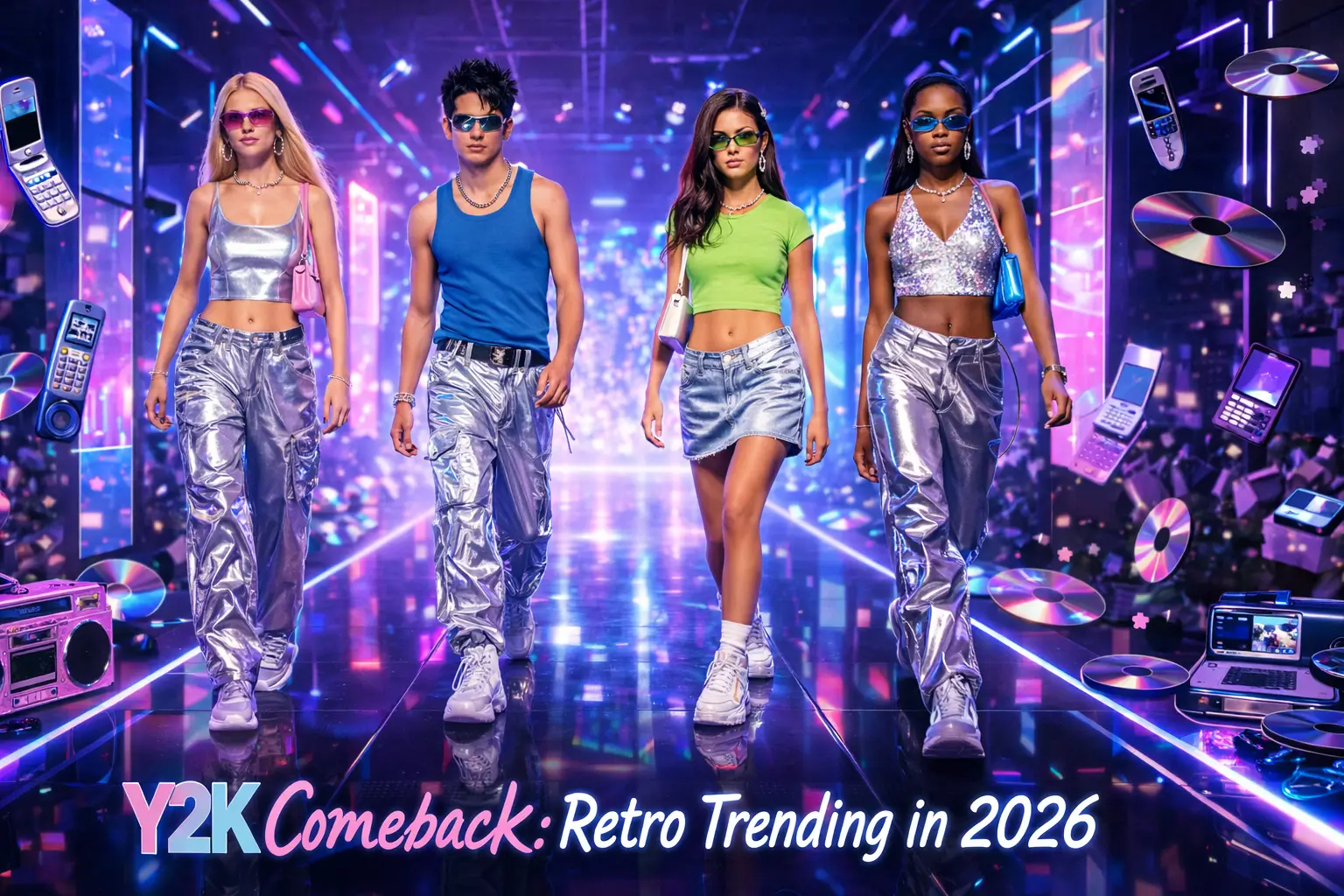
Y2K Comeback: Is Retro Still Trending in 2026?
Low-rise jeans. Butterfly clips. Frosted tips. The early 2000s called — and honestly? Everyone picked up.
Y2K Comeback isn’t just a hashtag anymore. It’s the whole vibe. And I’m not saying that because some trend report told me to — I’m saying it because last Tuesday I watched a 19-year-old at a coffee shop in Lahore pull out a hot-pink metallic tote bag that looked like it was smuggled straight out of a 2003 Claire’s clearance bin. She looked incredible. I felt confused and nostalgic at the same time. Welcome to 2026, I guess.
Consequently, here we are. Another year where the early 2000s refuse to stay dead. But is this retro wave still going strong, or are we finally watching it fade out? Let me break it down — not as a trend analyst with a fancy spreadsheet, but as someone who genuinely remembers wearing cargo pants with sixteen pockets and thinking that was fashion.
Y2K Comeback: Why the Early 2000s Never Really Left
Y2K Comeback started picking up serious steam around 2020-2021, but here’s the thing most people get wrong — it never actually began as a fashion trend. It started as a coping mechanism. Hear me out.
When the pandemic hit and everyone was stuck at home, people started digging through old photos, rewatching early 2000s reality TV, and inevitably… dressing like it. TikTok was the accelerant. Suddenly, Lizzie McGuire aesthetics were getting millions of views, and Gen Z was discovering a whole universe of fashion that felt both foreign and thrillingly new to them. Meanwhile, millennials were just sitting there going, “wait, I lived through that.”
Furthermore, there’s a psychological layer here that’s genuinely fascinating. Nostalgia is most powerful for eras you didn’t personally experience. Gen Z kids born in 2004 or 2005 have almost zero actual memories of the Y2K aesthetic — so to them, it doesn’t feel like a throwback. It feels fresh. That gap is precisely why the trend has legs that most retro revivals don’t.
Additionally, the early 2000s had this unique quality of being simultaneously optimistic and chaotic. Pre-social-media, post-grunge, peak pop culture excess. Paris Hilton was everywhere. Von Dutch hats were happening. People were bedazzling things that absolutely did not need to be bedazzled. There’s a wild, unfiltered energy to that era that feels almost rebellious compared to today’s hyper-curated Instagram aesthetic.
Y2K Comeback in Fashion: What’s Actually Still Trending in 2026
Y2K Comeback fashion in 2026 looks a little different from the 2022 version, and that distinction matters. The first wave was basically chaos — every Y2K element thrown at the wall to see what stuck. Low-rise everything, bedazzled everything, velour tracksuits and butterfly clips making simultaneous comebacks.
Now, however, things have gotten more… selective. Refined, even. Which is a weird word to use for an aesthetic that once celebrated visible thong straps, but here we are.
Specifically, what’s dominating street style and runways in 2026:
Micro sunglasses — still going, somehow. Completely useless for actual sun protection, but aesthetically? Chef’s kiss.
Cargo pants — but make it fashion. Not the giant beige ones your dad wore to Home Depot. Sleeker, fitted versions in interesting fabrics.
Baby tees and fitted tanks — this honestly never needed a comeback because it never really left, but it’s front and center again.
Platform shoes — chunky soles are still here, though they’ve evolved. Less rave, more everyday.
Y2K-inspired knitwear — tiny cardigans, crop sweaters, that specific pastel-meets-sherbet color palette.
Moreover, the accessories game has gotten genuinely creative. Beaded jewelry is everywhere — and I mean everywhere, from high fashion boutiques to market stalls in Karachi’s Liberty Market. Tinted tinted lip gloss (the glossier the better), tiny handbags that fit basically nothing, and those chunky layered necklaces that look like you raided your cousin’s jewelry box circa 2002.
The interesting thing, though, is how luxury brands have gotten in on it. Versace, Blumarine, Coperni — these houses have all done serious Y2K-adjacent collections in recent seasons. Therefore, what started as a TikTok microtrend has officially been absorbed by high fashion. Which, if history is any guide, means it’s simultaneously at its peak and starting to die. Classic fashion cycle stuff.
Y2K Comeback in Music and Pop Culture: The Soundtrack of Nostalgia
Y2K Comeback isn’t just happening in closets — it’s absolutely everywhere in pop culture right now. And honestly, the music side of this is where it gets really interesting.
Think about what’s been charting in 2025 and early 2026. There’s been a noticeable surge in maximalist pop production — big hooks, bubblegum synths, almost aggressively catchy choruses. Compare that to the moody, understated indie dominance of the early 2010s and you’ll notice we’ve swung hard in the other direction. Consequently, artists like Sabrina Carpenter, Ice Spice, and a wave of newer acts have leaned into a sound and visual aesthetic that’s deeply informed by early 2000s pop. Britney-core is real. Destiny’s Child-coded fashion moments are getting millions of engagements.
Reality TV is also doing a full Y2K nostalgia lap. The reality TV format itself — which basically exploded in the early 2000s with shows like Big Brother, Survivor, and The Simple Life — has been having a massive renaissance. Moreover, the return of Paris Hilton to cultural relevance is genuinely one of the more unexpected stories of the decade. She went from being the punchline of early 2000s excess to being… weirdly respected? Admired, even. Her DJ career, podcast, and rebranding have been a masterclass in cultural rehabilitation.
My personal theory — and I’ll stand by this — is that the specific appeal of Y2K culture is its pre-self-consciousness. There was no algorithm optimizing Paris Hilton’s content. Von Dutch hats weren’t A/B tested. People just… did things. Wore things. Released music. It had an authenticity through sheer obliviousness that’s almost impossible to replicate in the current era of hyper-strategic personal branding.
Y2K Comeback vs. Other Retro Revivals: What Makes This One Different
Y2K Comeback stands apart from previous retro revivals, and it’s worth understanding why — because not every decade gets this kind of sustained cultural resurrection.
Consider the 70s revival of the 90s. Or the 80s revival that happened in the 2000s. Those were relatively contained: specific fashion elements (flares, shoulder pads) got recycled, some music got sampled, and that was mostly it. But the Y2K revival has been unusually comprehensive. Fashion, music, aesthetics, celebrity culture, technology nostalgia (flip phones, anyone?), even design sensibilities — all of it has come back simultaneously.
Furthermore, the internet has changed how retro revivals work. In the pre-social-media era, trends moved through magazines, music videos, and store windows. Now, a kid in Manila, a teenager in Lagos, and a college student in Lahore can all discover the same Y2K aesthetic video at 2am and immediately start incorporating it into their wardrobe choices. The revival is genuinely global in a way previous ones weren’t.
Additionally, there’s the technology angle. Y2K was the last aesthetic era before smartphones reshaped everything. Early digital cameras with their specific image quality — grainy, slightly washed out, often overexposed — have become their own aesthetic. VSCO filters trying to replicate that look. Apps literally designed to make your photos look like they were taken on a 2003 Nokia. There’s something deeply poignant about the most technologically sophisticated generation in history fetishizing the limitations of older tech.
Ever wonder why the low-fi, imperfect image quality thing resonates so hard? I think it’s because it feels unfiltered. Pre-optimization. Like the picture wasn’t taken to get likes — it was just taken.
Y2K Comeback: Is It Already Over, or Just Getting Started?
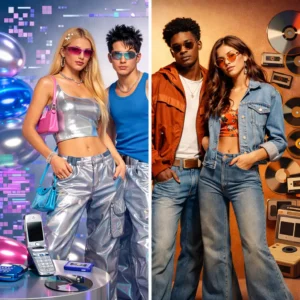
Y2K Comeback has been “dying” for about three years now, according to various trend forecasters who’ve been consistently wrong about it. So let’s actually think about this properly.
On one hand, there are clear signs of saturation. When something goes from TikTok to high fashion to fast fashion to your local mall’s window display, the cycle is usually wrapping up. H&M doing Y2K collections means it’s been fully absorbed into the mainstream — which typically signals the end of a trend’s edge.
On the other hand, however, Gen Z isn’t done with it. And here’s why that matters: Gen Z has shown a particular tendency to hold onto aesthetics longer than previous generations, precisely because they discovered them online and formed genuine community around them. It’s not just clothes — it’s identity. Moreover, the next wave of Y2K-influenced design is already emerging in tech and interior design spaces, which suggests the cultural moment is expanding rather than contracting.
I talked to a friend who runs a vintage clothing store in Karachi — shoutout to her, she knows who she is — and she told me that Y2K pieces, particularly branded items from the early 2000s, have been consistently appreciating in resale value. Juicy Couture tracksuits. Von Dutch originals. Early 2000s Nike pieces. These aren’t dropping in demand; they’re going up. Specifically, the authentic originals are what people want, not the revival versions. That’s usually a sign of a trend that has matured into something more like genuine collecting.
Therefore, my read on it is this: the Y2K trend as a mass market fashion moment is probably plateauing. But Y2K as a cultural aesthetic touchstone is gonna stick around for a while. It’ll shift from “trend” to “influence” — which is actually the longer, more sustainable form of cultural impact.
Y2K Comeback and the Sustainability Question Nobody Wants to Ask
Y2K Comeback has a problem that the industry is remarkably good at dancing around. The original Y2K era was, fashion-wise, an environmental disaster. Hyper-consumption, cheap fast fashion, trend cycles measured in weeks not seasons. The revival of that aesthetic has come at a moment when there’s supposedly more awareness about the environmental cost of fashion.
So… how’s that working out? Honestly, it’s complicated.
On the positive side, the Y2K revival has driven a genuine boom in vintage and secondhand shopping. ThredUp, Depop, Vinted — these platforms have all reported significant increases in Y2K-era item searches over the past few years. Consequently, people aren’t just buying new Y2K-inspired fast fashion; a meaningful portion are actually hunting for authentic pieces. That’s actually a more sustainable consumption pattern than most trend revivals generate.
However — and this is a big however — fast fashion brands have absolutely capitalized on the trend with cheap, disposable Y2K-inspired pieces. Shein’s Y2K category is enormous. Furthermore, the churn rate of microtrends on TikTok means that even within the Y2K umbrella, specific sub-aesthetics (coquette-Y2K, grungy Y2K, Y2K streetwear) are cycling in and out rapidly. That’s not great for anyone’s carbon footprint.
The niche insight here that most trend pieces miss: the most economically and environmentally efficient way to participate in the Y2K revival is also the coolest way — actual vintage. The hunt is part of the appeal. Going through your mum’s old wardrobe (honestly, do this — you’d be shocked what’s in there) or digging through charity shops is both cheaper and generates infinitely more interesting finds than anything fast fashion can offer. Additionally, it comes with a story. And stories are what make fashion actually interesting.
Y2K Comeback Around the World: It’s Not Just a Western Thing
Y2K Comeback looks different depending on where you are, and this is genuinely underappreciated in most trend coverage that centers Western markets.
In South Asia — and I’m specifically thinking about what I see in Karachi and Lahore — the Y2K revival has intersected with local fashion traditions in fascinating ways. There’s a particular fusion aesthetic happening where the bold colors and maximalist layering of Y2K meets the embellishment traditions of South Asian fashion. The result is something that feels distinctly regional while clearly drawing from the same global nostalgia wave. Desi Y2K is a real thing, and it slaps.
In East Asia — Japan, South Korea, and increasingly China — the Y2K revival has been filtered through different local aesthetics. Korean fashion, specifically, has its own complicated relationship with the era, given that Korean pop culture was having its own distinct moment in the early 2000s. The Hallyu wave was just beginning; some of those early 2000s K-pop visuals are genuinely fascinating to look back on now through a contemporary lens.
Latin American markets have embraced specific elements — particularly the bold color palette and the accessories maximalism — and made them their own. Additionally, in Nigeria and across Anglophone West Africa, the Y2K revival has connected interestingly with Afrobeats visual culture, which has its own distinct maximalist tradition.
Therefore, what we’re actually seeing isn’t the West exporting a retro trend globally. It’s more like the same underlying cultural moment — global millennial nostalgia, Gen Z’s hunger for pre-algorithmic authenticity — manifesting differently in different regional contexts. That’s more interesting than the usual trend narrative.
Y2K Comeback: What Actually Comes Next
Y2K Comeback is entering its consolidation phase — and that means a few things are likely to happen.
First, the trend will splinter. It already is, honestly. “Y2K” as a monolithic aesthetic label is becoming less useful because the specific sub-aesthetics within it have diverged significantly. Coquette. Indie sleaze. Twee revival. Scene kid nostalgia. These are all branches of the same early 2000s tree, but they appeal to quite different communities and aesthetics sensibilities. Consequently, expect the Y2K umbrella to break apart into more specific micro-niches.
Second, the 2010s revival is coming. I know, I know — nobody’s ready for this. But the 2010s are now far enough in the rearview that nostalgia is kicking in. Early-2010s Tumblr aesthetics, Instagram’s Valencia filter era, the hipster peak, the height of normcore. Furthermore, some of this is already bubbling up — Lana Del Rey’s early aesthetic is having a moment, dark academia has been brewing for a while, and I’ve genuinely seen people wearing those thick-framed glasses with the colored lenses that were everywhere in 2012.
Third — and this is my actual hot take — the next big retro revival won’t be visual. It’ll be behavioral. The thing about the early 2000s that’s most alien to contemporary life isn’t the fashion or the music. It’s the pace. The lack of constant connectivity. The ability to just… be somewhere without documenting it. Accordingly, I think we’re going to see a cultural movement around intentional disconnection and presence that takes significant inspiration from the pre-smartphone era. Not quite a fashion trend, but a lifestyle one. And it’ll probably involve a lot of flip phones as aesthetic props, which — honestly fine.
Y2K Comeback: The Verdict
Y2K Comeback, to give you the honest assessment: it’s real, it’s been real for several years, and it’s not going anywhere fast — but it is changing shape.
The mass market version of it is probably past peak. The boutique, curated, vintage-authentic version of it has years left. And the cultural DNA it’s injected into 2026’s aesthetic landscape isn’t going anywhere regardless. That specific early-2000s energy — maximalist, unself-conscious, aggressively colorful, blissfully pre-optimized — has left a mark on how a whole generation of designers, musicians, and creatives think about what “fun” looks like.
Moreover, maybe that’s the real lesson here. The thing people are nostalgic for isn’t actually low-rise jeans or Von Dutch hats. It’s the feeling of an era that hadn’t figured out how to be anxious about itself yet. An era that was just… doing stuff. Loudly. Confidently. With a lot of rhinestones.
Is that a fashion trend or a philosophy? Both, probably. And in 2026, we’re still buying into it — literally and figuratively.
Now if you’ll excuse me, I have a vintage Juicy Couture tracksuit listing to go refresh on Depop. Don’t judge me.